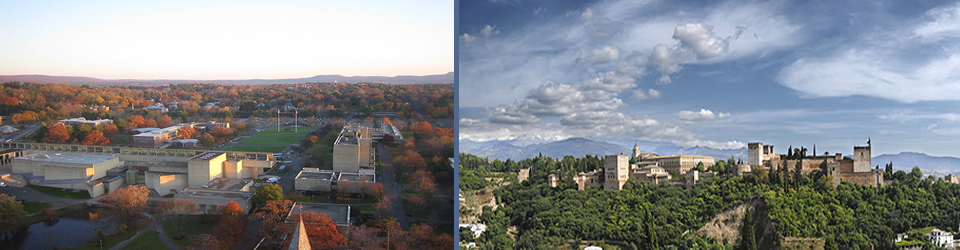
My carnet estudiantil for UH.
Experience
What has studying Spanish earned me? A deep knowledge of another language not my own; a familiarity with the Romance languages more generally, which has helped me in learning French and Portuguese; a comfort with the process of language-learning from 0.
What has the process of acquiring a Spanish degree at UMass earned me? Experience in reading texts written in Spanish, and the ability to analyze literature not written in my own language; friends in the form of peers and professors with similar passions; sharpened skills in written and spoken Spanish.
What has a semester at University of Havana earned me? A Cuban accent; a tan; friendships that span international waters; a firsthand experience of the living history of another country; knowledge from my classes on the history of Cuban art and architecture; confidence in everyday and conversational Spanish (ordering, arguing, bartering); a familiarity with a way of life really different from my own.
Even though the first two facilitated the third for me, it feels odd to compare these things. Though a Spanish major (like any diploma) is a task undertaken ostensibly with the purpose of gaining professional skills or making oneself marketable in the working world, my semester in Cuba, for me, was an experience of personal, not professional, enrichment.
Many, many people seem to talk about their semesters abroad as something like a 4-month-long vacation free of personal or academic responsibility. That makes me uncomfortable — should it? Is there an issue with using your semester abroad to visit as many bars and clubs in as many European countries as you can muster, and to take fluffy classes with gaggles of other Americans on topics like wine pairings and Medici castles? …What’s the issue with having fun? I had fun, too. And I would be lying if I said that the majority of the valuable things I learned were told to me by professors in classrooms.
Let me tell you what I got out of my semester abroad. I want to take a minute to talk about phone plans.
Etecsa
Before I went to Cuba I ordered a 64-dollar cellphone on Amazon. Verizon had just upgraded my family’s iPhones to the new 16, which was, I think, the first iPhone without a physical SIM card: only eSIM, which, I learned, is not available in Cuba. The plastic Android I bought was equipped with a dual SIM slot and emblazoned thus: “BLU / designed in Miami.” It seems BLU is some kind of Cuban expat brand designed for people who go back and forth a lot between the two countries. I had to order my SIM ahead of time.
A close-up of the FOCSA in all her glory. Tape “X”s on windows are to protect for hurricanes.
Setting the phone line up in person was an event that required waiting in line — itself a system completely different from how we queue in the USA — in the local ETECSA office, which is located in the FOCSA, a 39-floor omnipurpose behemoth which contains apartments, offices, TV and radio studios, restaurants and hotels.
The office is staffed by ladies in blue shirts, blue skirts, and heels, and activating your SIM requires presenting your passport and forking over an essentially ceremonial fee of 90 pesos (at time of writing, 20 cents, según el Toque) for the card itself.
I forgot to mention that loitering outside that ETECSA office, there was a guy in a Real Madrid shirt who pegged us as foreigners and tried to convince us that he worked for ETECSA and that although the office was closed he could recharge our phone minutes himself.
Recharging your prepaid phone plan involves visiting an ETECSA kiosk and reading your eight-digit Cuban cell number through the barred window to a woman who looks up your account on a computer database and then adds the requested amount, which you provide in cash. I normally did mine in 500-peso installments, which got me something like 5 gigabytes of data (good for a week or two) if I purchased a package deal. My preferred kiosk was located right next to a woman who sold used books and would always stop me to show me new books she’d bought. My most interesting purchase was a paperback transcription of Castro’s famous two-hour speech, “La historia me absolverá,” issued on the twentieth anniversary of its delivery (1200 pesos). My least interesting purchase was a pair of bangle bracelets for a friend back home (250 pesos).
A few months into my semester in Havana, ETECSA announced “nuevas medidas” designed to bring foreign money into the country and, I was told, specifically to help them update their ancient technology. Essentially — and I believe it’s this complicated on purpose — 300 CUP (Cuban pesos), once loaded onto the phone line, could still be redeemed at will for a certain amount of data (let’s say 2 gigs) but only up to 350 CUP could be loaded onto the phone line per month. This is obviously a problem, and did I mention that Wi-Fi is a rarity in Cuba? What I heard was that there’s a years-long waiting list to get a router in your house, although some people “know a guy” who can get it installed faster.

Saira and Juanca waiting outside FoxCell to get a phone fixed (get it? Sounds like FOCSA)
If you want more data, you are basically S-O-L, unless you have an uncle in Miami. The policy is that to get more CUP on your phone line, you can have someone outside of the country pay at a ridiculous rate, something like 25 dollars for 500 pesos, to recharge your Cuban SIM card. No, American credit cards don’t work on the island. The person wiring you the money has to be stateside.
People were enraged! Students, specifically, felt betrayed by the measures, which were going to make it prohibitively expensive to watch movies, download software, turn in schoolwork on Whatsapp, any internet-enabled activity you can imagine: professional, leisurely or academic. Cuba, having rapidly become digitized in the last years, was going from subsidized cell service to what people felt to be a state-run scam. People shared memes about how after the medidas were implemented, evr1 ws gna B typng lk ths 2 fit mor wrds in2 a txt & sav $$ on msgs.
Not only that, but there were protests, too. Students at the University of Havana began a strike where no one was to attend class until ETECSA changed the policy. They were backed first by the student union of the college of Mathematics and Computation, then other student unions, and the strike gained national recognition. Some professors supported the strike and opted not to penalize students who didn’t attend, others were less gracious. I remember arriving on Friday to an almost empty literature class (this was during finals!) having not received the memo but soon realizing what was going on.
I may be underrepresenting how historical this event was. My peers explained to me that in Cuba there have not been student strikes since the pre-Revolution days when activists like Julio Antonio Mella were martyred. The strike made the news and was even acknowledged by President Díaz-Canel. Some departments had resolved to stay out of class until a deal was struck, but most students were back in school on Monday and the excitement was absolutely palpable.
I left the country before the final deal was struck between ETECSA officials and FEU (student union) student representatives. Cuban visa policy is strict; I had to leave on exactly June 16 and wasn’t allowed to travel to other countries during my stay. But there was an electric feeling to have been surrounded by history as it was being written, and to be aware of this fact in a way one seldom is. A history written by other people, but people I knew, people I had class with, who had the grace to show and tell me what was going on despite my ignorance.
There is a slogan associated with the Revolutionary government: en silencio ha tenido que ser. It was once used to explain to me the general policy of secrecy that the Cuban government has about its operations especially when it comes to the outside world. It is impossible, impossible to get an accurate read on anything happening inside Cuba as a curious American observer who just wants to know what’s going on. But the openness and the friendliness shown to me by every Cuban person I spoke with during my semester in Havana took me aback: I felt an immense privilege to be let in on what is (for at times logical and at times illogical reasons) largely a secret to “outsiders” and Americans. That is: What the hell is happening in Cuba? To be shown, in a capacity limited by the short time I was in Cuba, the everyday and the political workings, the good and the bad — and, being an American, to serve as some form of unofficial cultural ambassador myself — was to see the iron curtain pulled back, if only for 112 days.
Meditation on “purpose”
The experiences that I have let you in on are ones of immeasurable value to me.
To have lived these things: Is that the point of studying abroad?
– I think maybe.
Is that the point of majoring in Spanish?
– Probably not.
Does this rationalize the way I cringe when I have to talk about going abroad, knowing full well that when people hear that phrase, they imagine 4 months spent cavorting in Europe?
– I hope so.
Is there anything wrong with cavorting in Europe or am I simply biased in favor of my own experience due to its mystical and blinding amazingness?
– Perhaps both.
Is the “point” of any activity, perhaps, whatever the individual manages to take away from it?
– Almost certainly.
Is “the point” something worth reasoning out?
– …
Would I have gotten to do any of this without a Spanish major?
– No.
So thank you, Spanish major, and thank you Spanish, and thank you bilingualism, and thank you human connection, and curiosity, and patience. And a toast to all of these.