
Dr. Warren was one of 5 experts invited to testify at a hearing before the Boston City Council on June 18. The hearing was called to discuss and assess current and future tree coverage in the City of Boston. Dr. Warren testified on the topic of equity in tree canopy cover distribution in Boston and other cities around the country.

Boston exhibits considerable variation in levels of tree canopy across the city, with some neighborhoods supporting lush, shady streets, and others virtually treeless. Studies are divided, however, on the question of equity (systematic disparities in access to tree canopy). A 2014 study from the Warren lab found income disparities, with higher canopy cover in wealthier areas, but another 2014 study found no income relationship. Both studies agree that there are not significant racial disparities in access to tree canopy cover across the city. Dr. Warren pointed out, however, that even when current canopy coverage is not inequitably distributed, there can still be issues with equity in the process of tree planting.

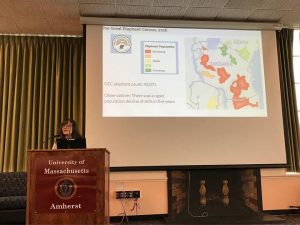 Jodie‘s research on male elephant social behavior in different parks and reserves in Tanzania is part of an ongoing project with the School for Field Studies, and she collected her data under the advisement of Dr. John Kioko. Jodie joined the Warren Lab as a field crew technician during the summer of 2017 to help with graduate student Kit Straley’s dissertation on the Wood Thrush, and she analyzed nest camera footage for parental behaviors during her last semester at UMass. Her passion for animal behavior and conservation is inspiring, and she shared that passion by presenting her elephant work at an undergraduate research conference this past month. Way to go, Jodie!
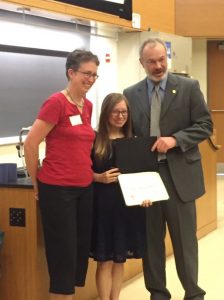 Christina‘s research focuses on the effects of urbanization on ectoparasite loads, anthropogenic nest materials, and nestling health in the House Wren. She joined the lab during the summer of 2017 as a field crew technician to help with graduate student Aaron Grade’s dissertation on the House Wren. She stayed on in the lab during the semester to begin dissecting the very nests she so carefully monitored during the summer. Conclusion: wrens are dirty messy birds. She persevered through thousands of mites, and helped the lab develop an assessment tool for mite loads which we will continue to use in the future. Today Christina did an excellent job presenting her findings to her program. Way to go, Christina!


