
Congratulations to Laura Townsend, Ian Goodine, Aliecia Bottali, and Tyler Sullivan. The four MIE 211 (Strength of Materials) UTAs win the MIE Students of The Year Award 2021. Laura Townsend and Ian Goodine win the ME Social Impact Award, Aliecia Bottali and Tyler Sullivan respectively win IE Research Star and Outstanding Growth Awards. The winners were nominated and finally selected after the voting by the entire faculty of the MIE department. They all showed an enthusiastic and thorough attitude and strong assistant to Prof. Xian Du’s teaching of this large size class.
Lab research topics under NSF grants
The lab ongoing research projects under NSF grants include:
- Monitoring and Control of Roll-to-Roll Printing of Flexible Electronics through Multiscale In-Line Metrology. See details in https://nsf.gov/awardsearch/showAward?AWD_ID=1916866&HistoricalAwards=false.
- Modeling the Roll-to-Roll Soft Lithography Printing Process Through Deep Learning and Real-time Sensing. See details in https://www.nsf.gov/awardsearch/showAward?AWD_ID=1942185&HistoricalAwards=false.
- Manufacturing USA: Precision Alignment of Roll-to-Roll Printing of Flexible Paper Electronics Through Modeling and Virtual Sensor-based Control. See details in https://www.nsf.gov/awardsearch/showAward?AWD_ID=1907250&HistoricalAwards=false.

Contact xiandu@umass.edu if you are interested in the projects.
Congratulations to Peter DiMeo for Winning First Place in the NSF Poster Competition in the 2020 International Mechanical Engineering Congress and Exposition (IMECE)
A junior NSF REU student, Peter DiMeo, developed a motorized device capable of autofocusing images in real-time in Summer 2020 in Du Lab. This technology was presented in the NSF poster competition in the IMECE on Nov. 16-19, 2020, and won First Place in the Overall-NSF Research Awards.
Design of PDMS stamp casting machine (Capstone senior design project 2019-2020)
 A senior design team (Jonathan Rajcula (Team Lead), Nicholas Bougler (Design Lead), Max Armbruster
(Fabrication Lead), Daniel Dell’Anno (Analysis Lead), Jiacheng Xing (Evaluation Lead)) worked with the UMass Amherst Intelligent Sensing Lab on engineering a device to manufacture high quality micropatterned PDMS stamps in 2019 Fall semester and 2020 Spring semester. These stamps are to be used on a roll to roll microprinting machine being developed in the Intelligent Sensing Lab, which will utilize the stamps in fabricating flexible circuitry. The objectives of the project are to: 1) Learn the process of PDMS stamps and create a stamp compatible with the lab’s Roll to Roll Fabrication Machine. 2) Search for an appropriate material compatible with CO2 laser-etching serving as the PDMS mold. 3) Design and to improve a metal housing that holds the mold piece. 4) Find a sufficient method to evaluate the quality of the final prototype. 5) Measure the elastic modulus of the PDMS stamp, combining all of the tested results and anticipating an efficient modulus model that works properly with the project. The team has came up with a method to efficiently create patterns on a PDMS stamp by preprocessing a mold with patterns. Specifically, the mold is assembled with three parts, a two piece aluminum housing and an acrylic die. The team has done multiple experiments and has confirmed that acrylic is the material compatible with the CO2 laser-etching machine. With a series of incoming issues (housing leakage, flatness/thickness of the PDMS stamp), the team redesigned a new aluminum housing and improved its functions on dealing with mentioned issues. Some footage of the team doing work in the lab is reported in https://www.linkedin.com/posts/lisa-dell-anno-esq-706a95a5_daniel-dellanno-20-wasnt-planning-on-attending-activity-6615285033106231296-W4vk/.
Congratulations to Panyu Zhang for Graduate School Fellowship
Congratulations to Panyu Zhang, our new Ph.D. student, for his awarded 2021 Graduate School Doctoral Fellowship from the College of Engineering. Panyu will join our lab in September 2020.
2019 Summer BBQ
Thank Rui Ma (Ph.D. student) for organizing the successful 2019 Summer Barbecue party. We enjoyed great food, entertainment and fun in the sun (and shade). Additionally, we all learnt how to light charcoal and grill food. We look forward to brushing up on our grill skills.

Roll to roll parallelism calibration project (Capstone senior design project 2018-2019)
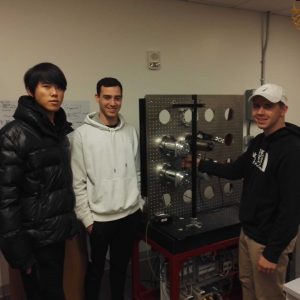 The goal of the project was to develop and fabricate an accurate, precision-based parallelism measurement device for a Roll-to-Roll (R2R) printing machine in the Intelligent Sensing Lab at UMass Amherst. For the printing process to run repeatedly without variance, all aspects of the machine must run accurately, however the principal component for the senior design team to consider for this project were the rollers. The overarching concern with regards to the rollers are their parallelism in the horizontal and vertical planes. If the rollers are not parallel with each other, the printing web that they feed will undergo tension and can potentially tear or crawl along the rollers. If the rollers are not precisely placed into the vertical breadboard of the machine, any testing done cannot be considered accurate and any printing done will not be exact, leading to poor overall printing quality. With these issues in mind a roller displacement measuring tool was conceived and produced in order to evaluate the rollers’ parallelism. The team’s design solution focuses on measuring distances from each roller to a reference beam for horizontal deflection and measuring distances from each roller to one another for vertical deflection. This is done by inserting an aluminum CNC machined square enclosement piece around each roller and using a caliper and caliper extension kit to mate with the aluminum piece and thus measure to the other rollers and reference beam. The project team consisted of four members, Suadad-Al Khamees, Thomas Regensburger, Harry Na, and Dominik Laszczkowski. The significance of Suadad’s contribution to the final product includes leading and organizing team to achieve milestones, developing a successful concept solution to the Roll-to-Roll precision problem that meets our sponsors goals for the project, and compiling a B.O.M as necessary for the final prototype. Due to Thomas’s prior summer research position he held in our client’s lab and the work he did (designed CAD model of R2R assembly in SolidWorks), he led in the design of all the CAD models for the project, which includes all modeled prototypes, the enclosement piece model, and the final assembly. Harry analyzed for potential modes of failure in the team’s various designs via FEA software and engineering application. Dominik assembled the prototype to test its design in order to gather feedback and where the design stood to help define some issues and problems that arose and help better prepare for the upcoming semester. After reaching out to A&D Metal Inc. for assistance with the project, Dominik worked closely with A&D Metal Inc. to establish machining criteria and the process that would allow for necessary design changes to properly and easily machine the team’s collet and adaptor design out of aluminum.
MeasureScope automation project (Capstone senior design project 2018-2019)
 Since the Fall of 2018, a team of senior undergraduate students in mechanical engineering have been working hard at converting a 1976 Nikon measurescope into a metrology tool capable of reproducible movement at a one micron resolution for automatic measurement of product pattern in roll to roll manufacturing. Through the implementation of precision machining, mounting and planning, the updated microscope will be capable of capturing detailed images and then piecing them together using the corresponding software. The microscope itself has been retrofitted using stepper motors and a system of planetary gearboxes and fine pitch lead screws. For additional user accessibility, a z-axis linear stage actuator was introduced to the system for gross camera autofocus adjustments and to clear the stage when mounting new specimens. Colin worked on the Y-axis and the electronics/mathematics. Mike worked on the x-axis and the coding. Sakshi worked on the z-axis and calibration. Brandon worked on the camera mount. They all did their own machining.
Summer projects
We finished two busy projects in summer: design, assembly, calibration and testing of the first prototype of R2R machine in the lab and metrology of the measurescope. We learned to build a machine from scratch and started a lab from mechanical and electronic tools. Thanks to all of the following students for contributing your time and effort to the startup of this lab: Jingyang Yan (PhD student), Jonathan Lombardi, Patrick Caviston, Bhavesh Parkhe (Master students), Thomas Regensburger, Dechao Zeng (senior students), Ian Teare-Thomas, Eileen Wang, Daniel Emerson(junior students).


Start of construction of the Intelligent Sensing Lab

The start of Intelligent Sensing Lab includes three key areas:
1. Machine design (flexible electronics printer and medical device);
2. Control (Sensing, metrology, pattern analysis, feedback control)
3. Machine intelligence (Machine vision, image processing, deep learning)
The interview of the first two Ph.D. students and one postdoc started this month. The following videos include useful information about the employment.
- https://www.facebook.com/GREedge/videos/1585957274800041/
- https://www.youtube.com/watch?v=Fl6jaEqSra0
I posted the three positions in the links:
- https://engineering.academickeys.com/job/it8cjdb4/A_funded_postdoc_position_for_intelligent_sensing_at_Umass_Amherst
- https://engineering.academickeys.com/job/7mxyjr8o/A_funded_PhD_Position_in_precision_engeering_at_UMass_Amherst
- https://engineering.academickeys.com/job/2vz9ribq/A_funded_PhD_position_in_Control_at_Umass_Amherst.
One more Ph.D. student or Postdoc will be needed in MRI image processing and pattern recognition soon.